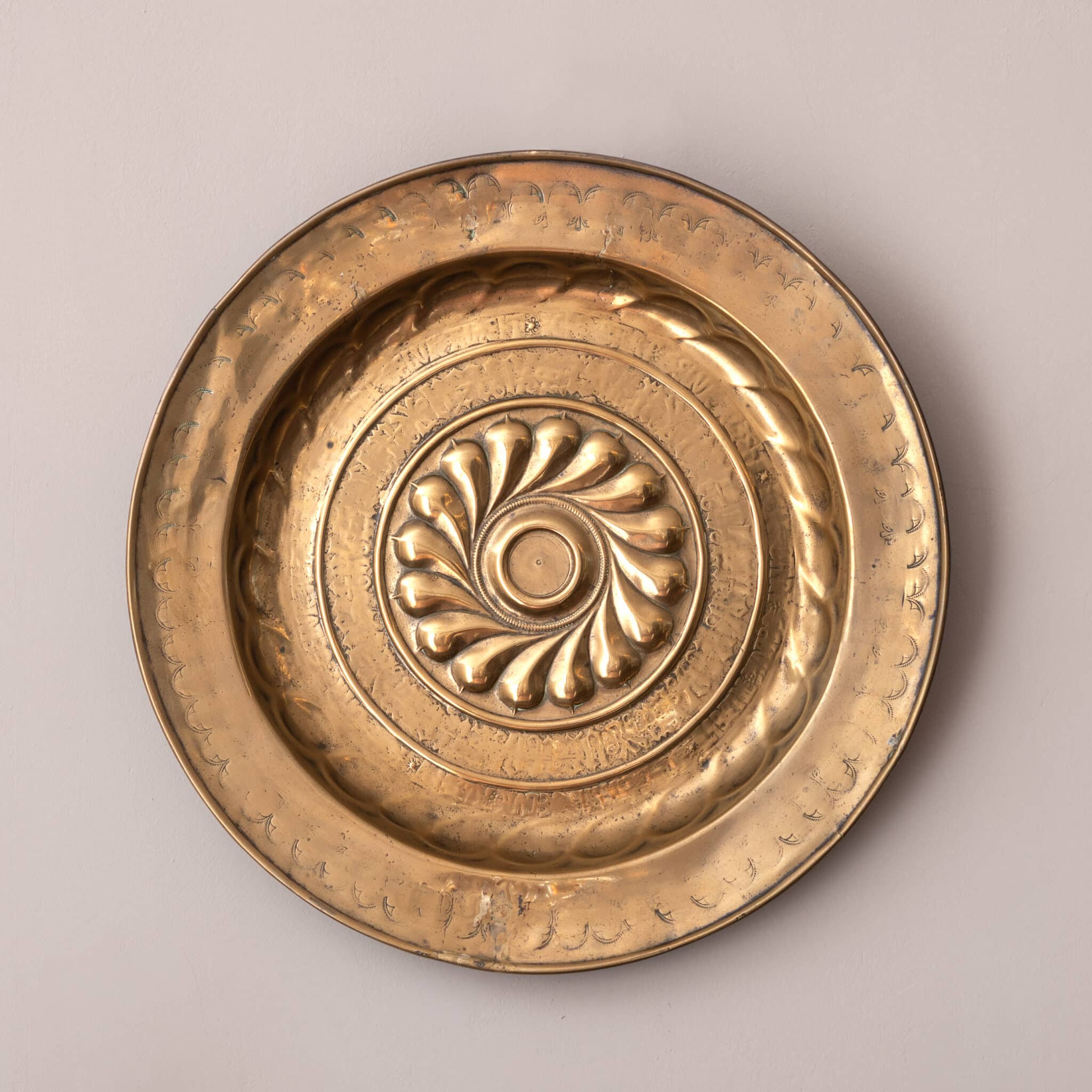
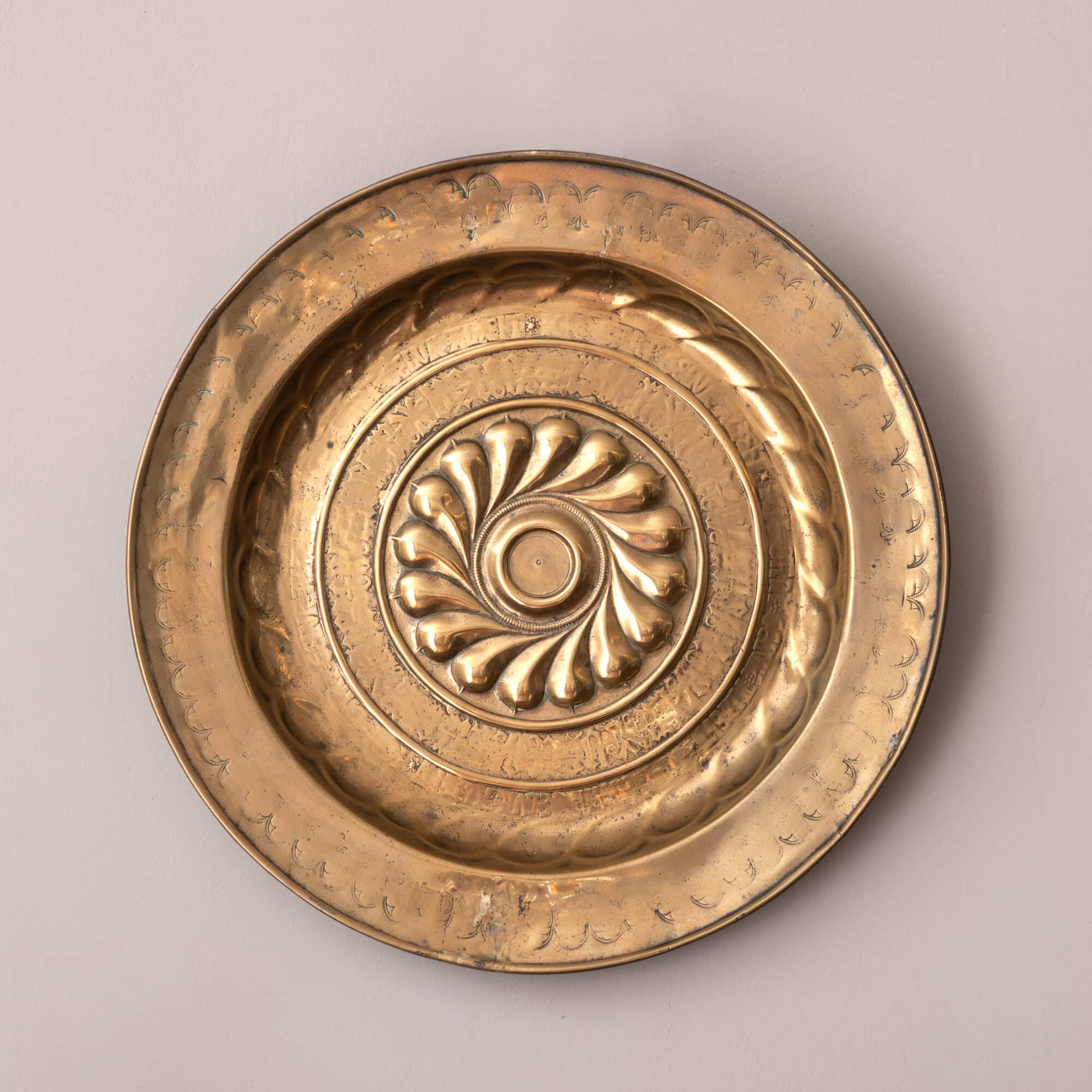
A Nuremberg Brass Alms Dish
- Period
- Early 16th century
- Origin
- Germany, Nuremberg
- Dimensions
- W 16 1/2" diameter" × H 1 1/2""
- Reference
- #Marh3799
£1,850
Description
A large early sixteenth-century Nuremberg brass dish of Beckenschlägerschüssel type, the centre worked in high relief with a vigorous rotating arrangement of curved lobes traditionally described in German scholarship as Fischblasen (‘fish-bladder’) ornament. The central motif is enclosed by concentric moulded rings and a band of Gothic inscription, while the broad cavetto is embossed with a continuous undulating design. The outer border is decorated with a repeated punched ornament beneath a rolled rim.
These distinctive brass dishes were produced in considerable numbers by the specialist brass-working industry of Nuremberg and were exported widely throughout Europe. Although frequently described today as ‘alms dishes’, their original functions were not necessarily exclusively ecclesiastical. Surviving examples appear to have served both secular and religious purposes, including use as basins and display vessels as well as for the collection of offerings.
The Fischblasenmotiv belongs to the late Gothic decorative vocabulary and became one of the characteristic central designs employed on Nuremberg dishes. Hermann P. Lockner, in his study of brasswork of the fifteenth to seventeenth centuries, notes the frequency of the motif amongst surviving Beckenschlägerschüsseln and illustrates an example of the general type dated to the beginning of the sixteenth century.
Literature
Hermann P. Lockner, Messing: 15.–17. Jahrhundert, Klinkhardt & Biermann; see the discussion of Fischblasendekor and the illustrated Beckenschlägerschüssel, fig. 56a, described as Germany, beginning of the 16th century.
Condition
The surface retains considerable evidence of age and use. Most conspicuous is an old area of damage and repair extending inward from the lower rim. The repair is itself historic and has subsequently worn together with the surrounding brass. Minor distortion, surface wear, old marks and losses to the punched and inscribed decoration are consistent with the long working life of an object now approximately five centuries old.