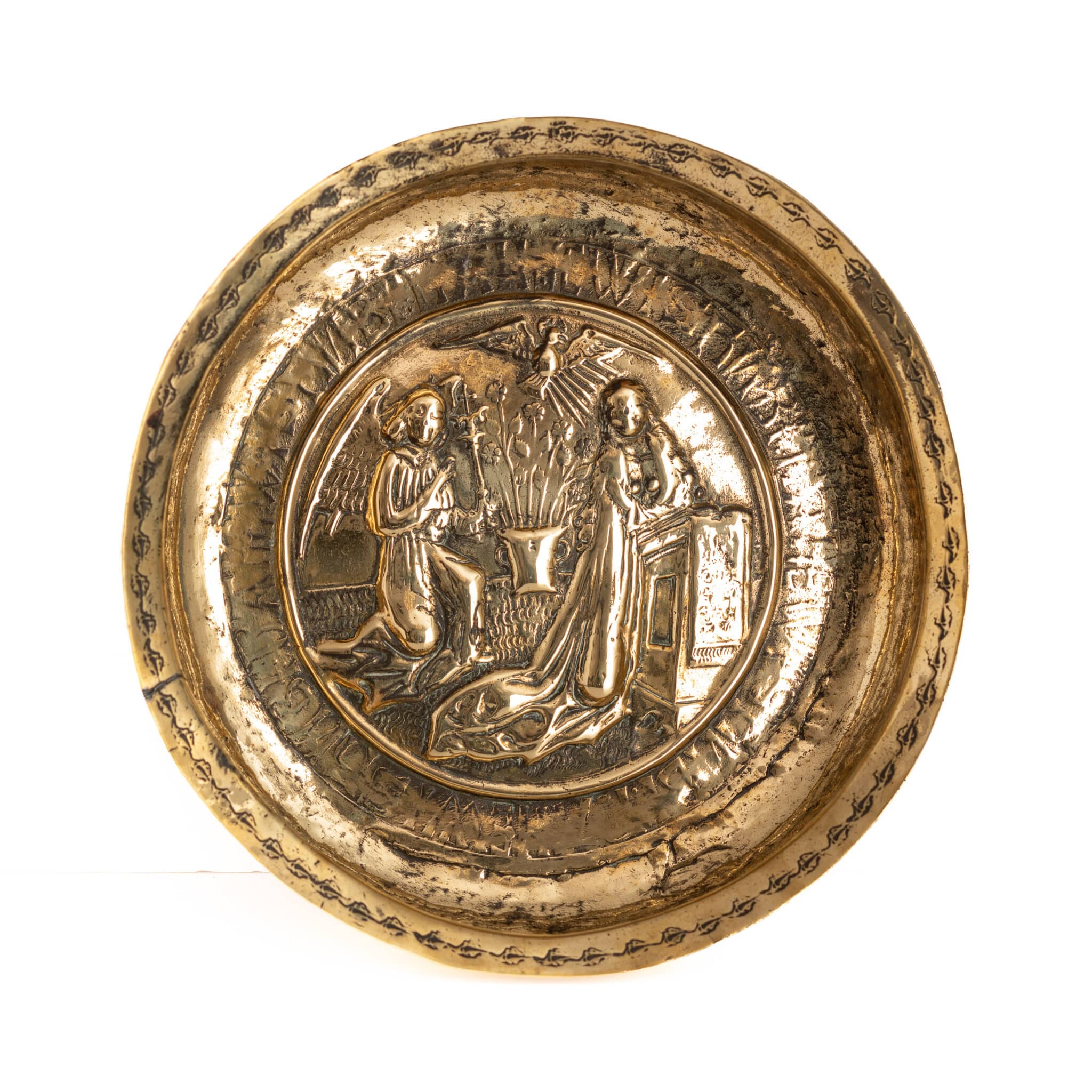
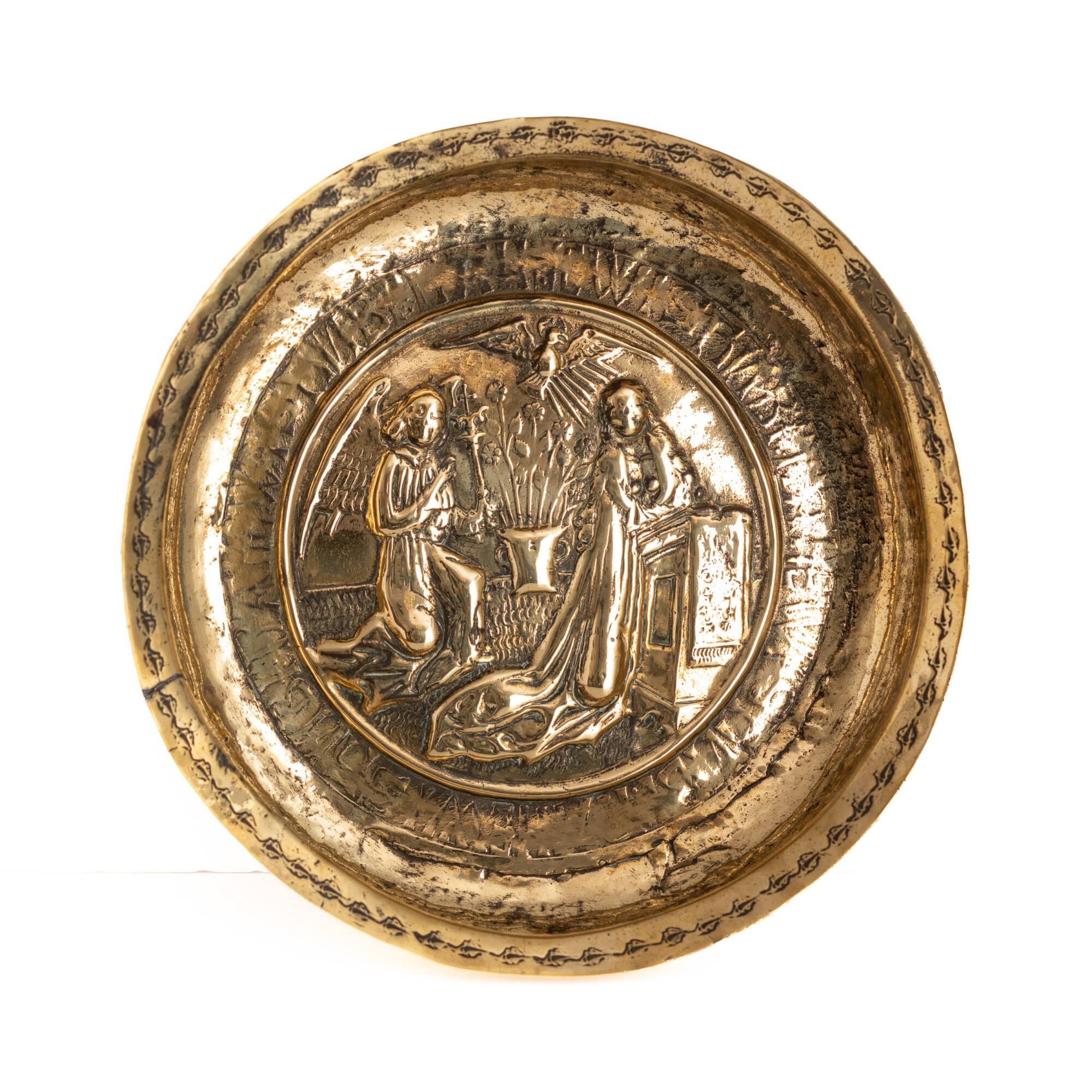
A Nuremberg Brass Beckenschlägerschüssel Depicting the Annunciation
- Period
- First half of the 16th century, circa 1500–1530
- Origin
- German, Nuremberg
- Dimensions
- W 11" diameter" × H 2 3/4""
- Reference
- #Marh3790
£2,850
Description
A deep hammered brass basin, or Beckenschlägerschüssel, the centre decorated in pronounced relief with The Annunciation. The Archangel Gabriel kneels to the left before the Virgin, who is shown at a prie-dieu to the right. Between the figures stands a vase containing lilies, the traditional symbol of the Virgin’s purity, while above appears the Holy Spirit in the form of a dove, descending upon rays of divine light.
The central scene is enclosed by a band of Gothic lettering, or pseudo-inscription, beyond which the broad hammered well rises towards an everted rim. The latter is embellished with a continuous sequence of small punched ornaments, providing a characteristic decorative border to the composition.
The basin belongs to the distinctive tradition of brass working associated with Nuremberg during the late fifteenth and sixteenth centuries. Known in German as Beckenschlägerschüsseln, these vessels were produced by specialist craftsmen who formed sheets of brass by repeated hammering and employed engraved negative matrices to create their principal relief decoration. Secondary ornament, including the decoration of the rim, was applied with individual punches.
The Annunciation was one of the religious subjects employed by these workshops. The composition of the present example belongs to a documented group showing Gabriel kneeling opposite the Virgin, with the vase of lilies occupying the centre and the dove of the Holy Spirit appearing immediately above.