Late Gothic Oak Sculpture of Saint Michael the Archangel Overcoming the Devil
- Period
- Circa 1480–1500
- Origin
- Lower Rhine or Eastern Netherlands
- Dimensions
- W 7"" × H 23 1/4" (lance 29 1/2")" × D 6 1/2""
- Reference
- #Marh3791
£7,850
Description
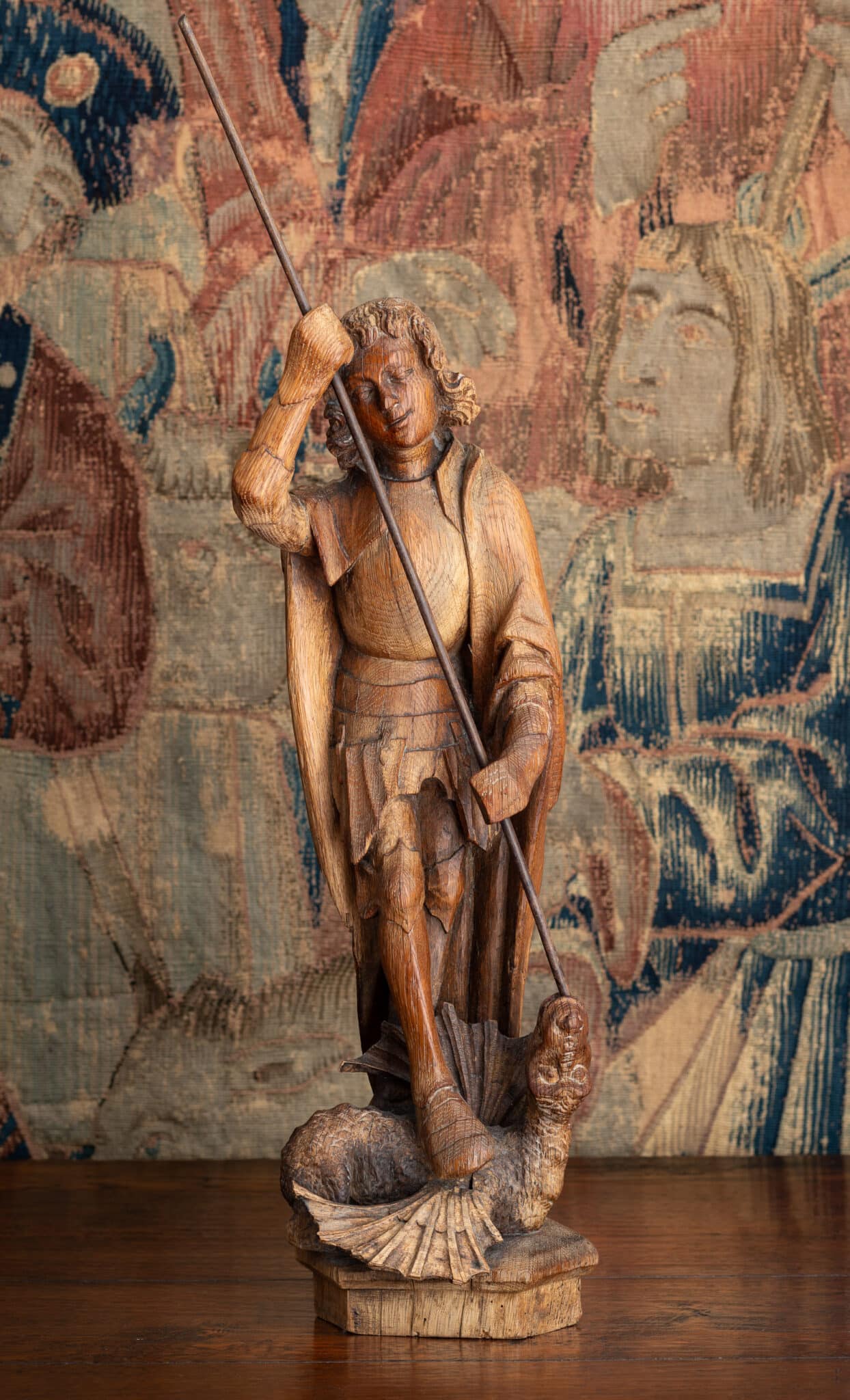
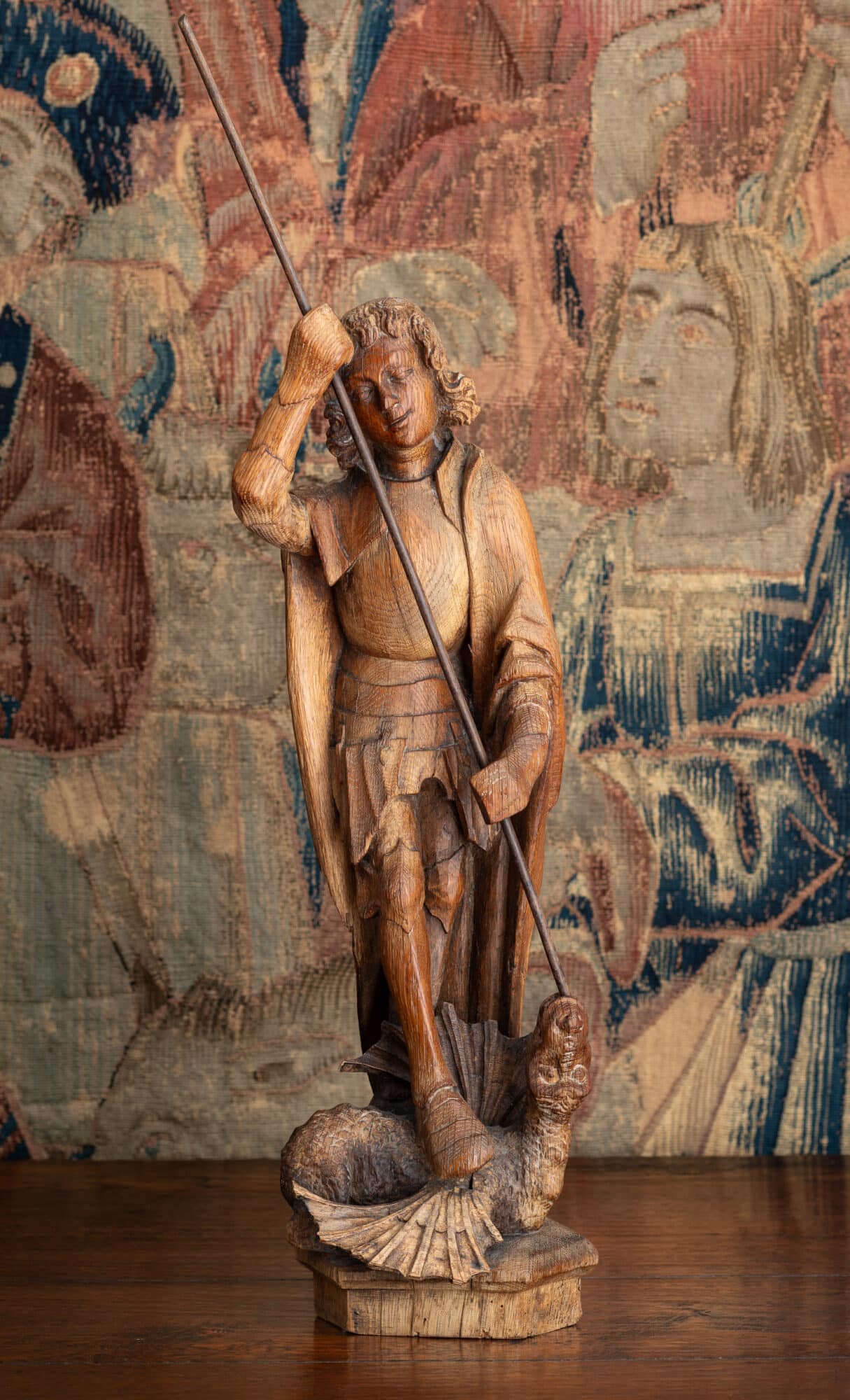
A late fifteenth-century oak sculpture representing Saint Michael the Archangel overcoming the Devil, conceived as a youthful armoured figure standing above and subduing a fantastic winged creature.
Saint Michael is shown with his head inclined gently towards his raised right arm, his expression notably serene in contrast to the violence of the subject. His youthful face is characterised by a broad forehead, elongated nose, small mouth and delicately defined eyes, framed by luxuriant locks of hair terminating in pronounced curls around the ears and neck. He wears armour rendered with characteristic late Gothic economy: a fitted breastplate above a narrow waist, articulated defences around the hips and thighs, and pointed shoulder pieces. A mantle falls vertically behind the figure, contributing to the strongly frontal composition.
Michael’s right arm is dramatically raised above his head to grasp a long lance, while his left hand steadies the shaft below. The weapon descends diagonally across his body towards the monstrous creature beneath his feet. The creature should be understood not simply as a dragon but as the Devil in draconic form, in accordance with the medieval iconography of Saint Michael derived ultimately from the Book of Revelation, in which Michael defeats “the great dragon… that old serpent, called the Devil, and Satan” (Revelation 12:7–9).
The treatment of the creature is particularly expressive. Its coiled body is compressed beneath the Archangel’s feet, while broad, ribbed wings spread across the base. The grotesque head combines animal and almost anthropomorphic characteristics, emphasising its supernatural rather than zoological nature. This juxtaposition between the composed, youthful Archangel and the contorted creature below is characteristic of late medieval representations of Michael as the celestial warrior and victor over evil.
Two substantial, symmetrically positioned mortices survive on the reverse of the shoulders. These almost certainly accommodated separately carved wings, now lost. Their former presence would have considerably enlarged the silhouette of the sculpture and immediately identified the youthful warrior as an archangel. The reverse is otherwise boldly worked and substantially left unfinished, indicating that the sculpture was intended primarily to be viewed from the front. It was therefore probably originally incorporated within an ecclesiastical ensemble, most plausibly an altarpiece or retable.
Stylistically, the sculpture belongs to the artistic territory extending between the Lower Rhine and the eastern Netherlands during the closing decades of the fifteenth century. The elongated proportions, restrained treatment of the armour, softly modelled youthful face and distinctive curling hair are consistent with sculpture produced within the interconnected workshops of this region. Centres including Kleve, Kalkar, Wesel and neighbouring Gueldersdeveloped vigorous traditions of wood sculpture in which Netherlandish and Rhenish characteristics frequently overlap, making modern national distinctions between “German” and “Netherlandish” inadequate for works of this type.
The sculpture’s comparatively substantial scale—approximately 59 cm to the head—together with its pronounced frontal presentation and separately attached wings suggests that it once occupied a significant position within its original devotional setting. The image of Saint Michael standing physically upon the defeated Devil would have provided medieval worshippers with an immediately comprehensible representation of the triumph of divine order over evil.
The oak retains an extensively aged surface with evidence of former polychromy. The original separately carved wings are lost, together with other age-related losses and wear. The surviving figure nevertheless preserves the essential composition with considerable clarity, including the unusually characterful representation of the defeated Devil at its base.