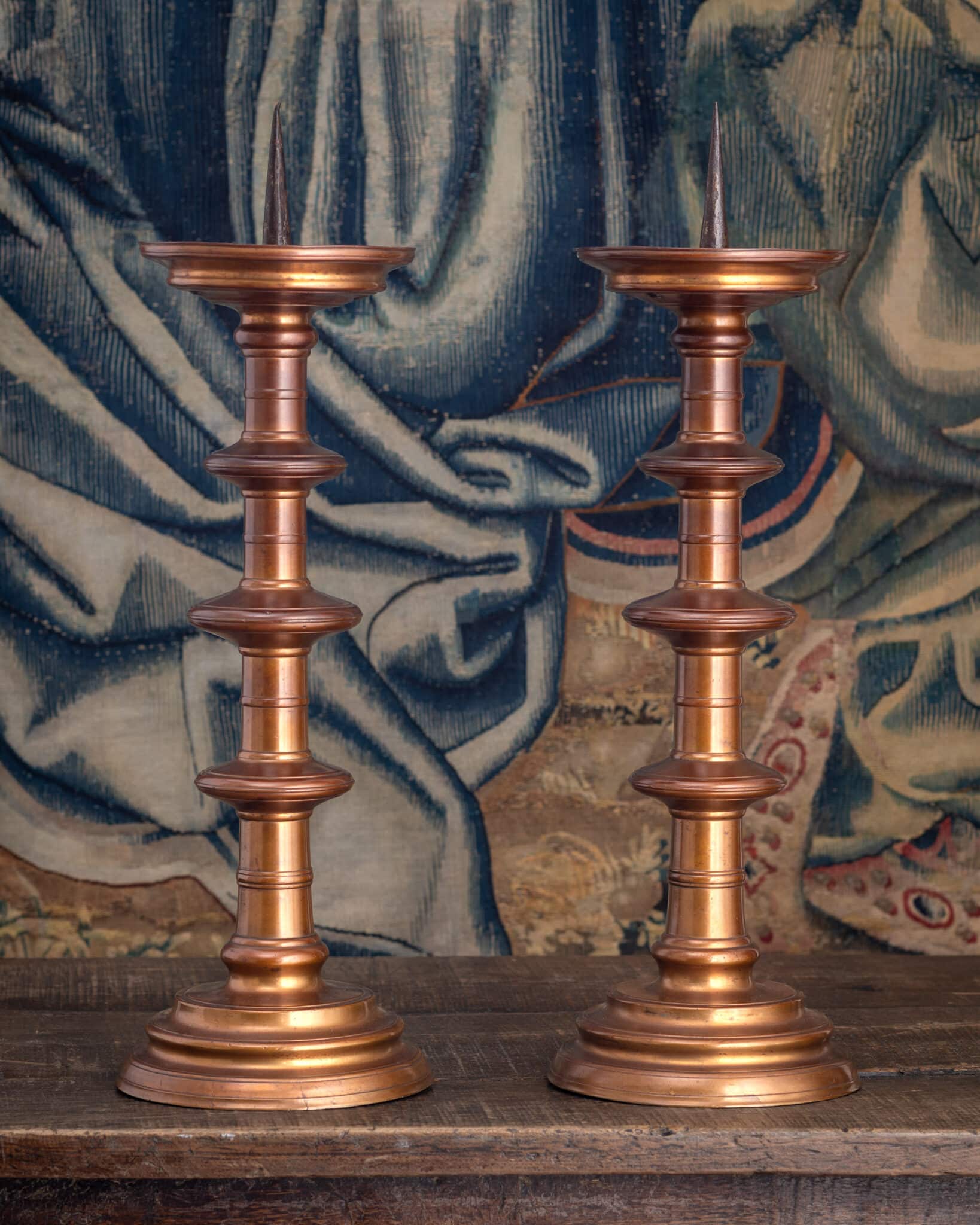
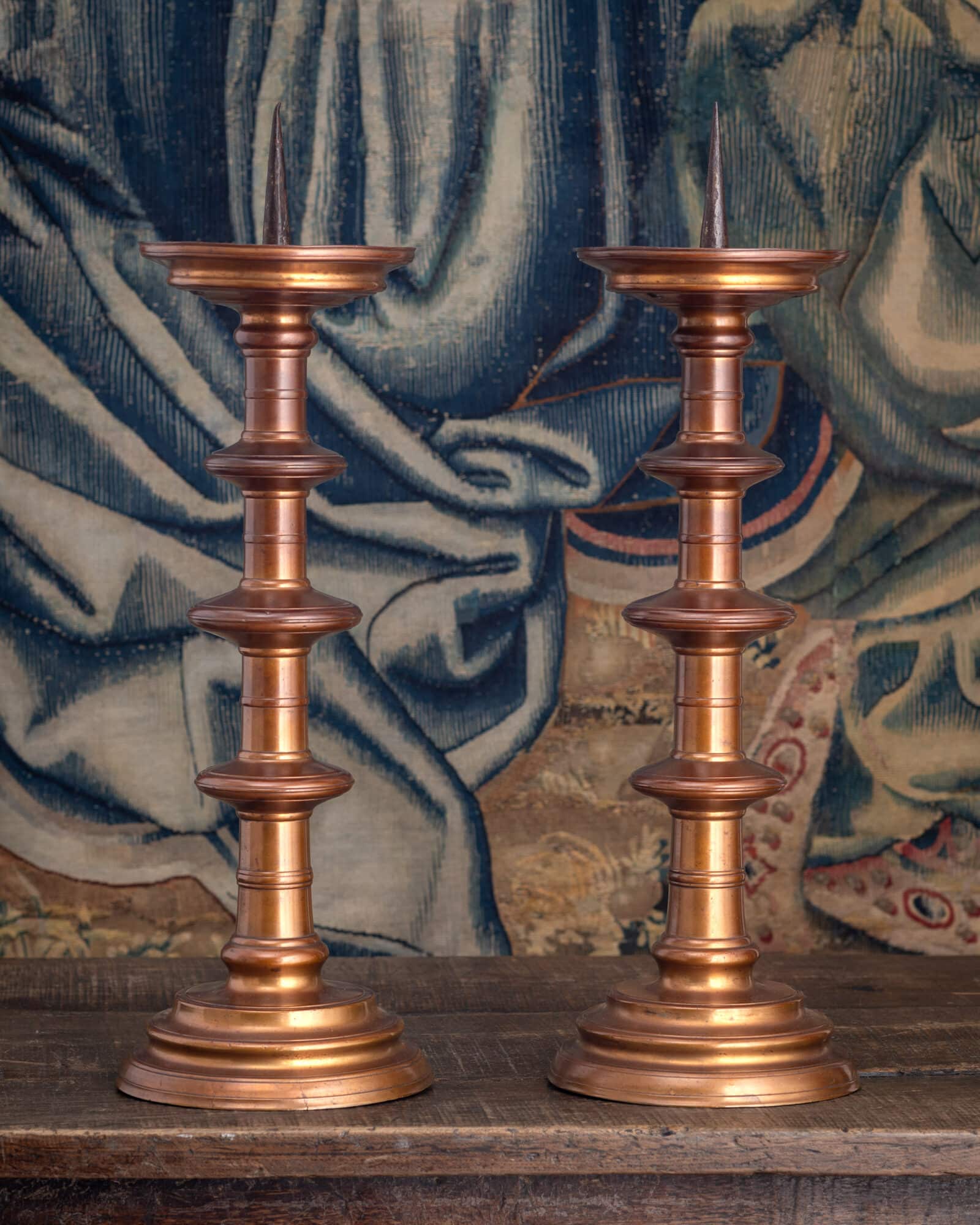
A Pair of Monumental Copper-Rich Brass Pricket Candlesticks (Scheibenleuchter)
- Period
- Circa 1500–1550
- Origin
- Nuremberg, Southern Germany
- Dimensions
- W 7 1/8" diameter " × H 21 1/2""
- Reference
- #Marh3825
£8,950
Description
A substantial and finely proportioned pair of early sixteenth-century Nuremberg copper-alloy pricket candlesticks, known in German as Scheibenleuchter, distinguished by their architectural form, accomplished hollow-cast construction and particularly pronounced copper-rich appearance.
Each candlestick is composed of a tall cylindrical stem articulated by three prominent, flattened disc-shaped knops, separated by elongated sections with finely executed concentric mouldings. The stems rise from broad, stepped circular bases and terminate in shallow circular candle dishes retaining their iron prickets. The carefully balanced arrangement of horizontal and vertical elements creates a strongly architectural silhouette characteristic of South German metalwork during the transition from the Late Gothic to the Early Renaissance.
Of particular interest is the unusually warm, reddish character of the metal, which differs markedly from the golden-yellow brass more commonly associated with surviving Nuremberg candlesticks of this form. The pronounced copper colouring extends across the stems, knops, candle dishes and moulded bases, lending the pair a distinctive and remarkably harmonious appearance. Although the precise composition of the alloy has not been established through metallurgical analysis, its visual character suggests a copper-rich material or surface composition, a feature of considerable interest within the study of early Nuremberg brass founding.
The candlesticks are of hollow-cast construction, with granular interior surfaces characteristic of unfinished cast metal, contrasting with the carefully worked and smoothly finished exteriors. The undersides of the bases retain concentric tooling marks associated with their manufacture and finishing. This combination of hollow casting and subsequent mechanical finishing reflects the technical sophistication of the metalworking traditions established in Nuremberg during the late medieval period.
Condition
The candlesticks are in good condition, with surface wear and minor irregularities consistent with their age and historic use. One candlestick has a small hole to the metalwork, which does not detract from the overall appearance of the pair.