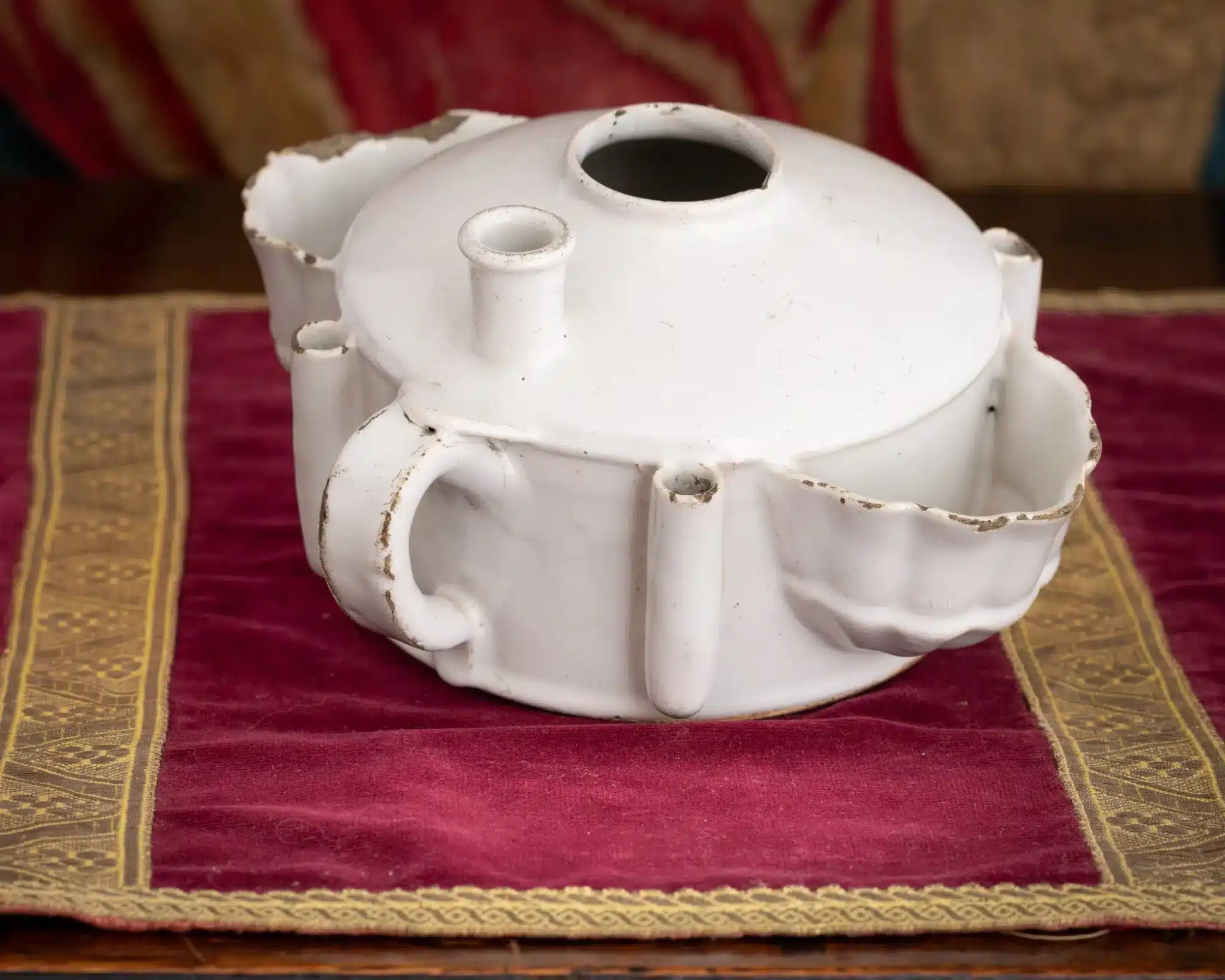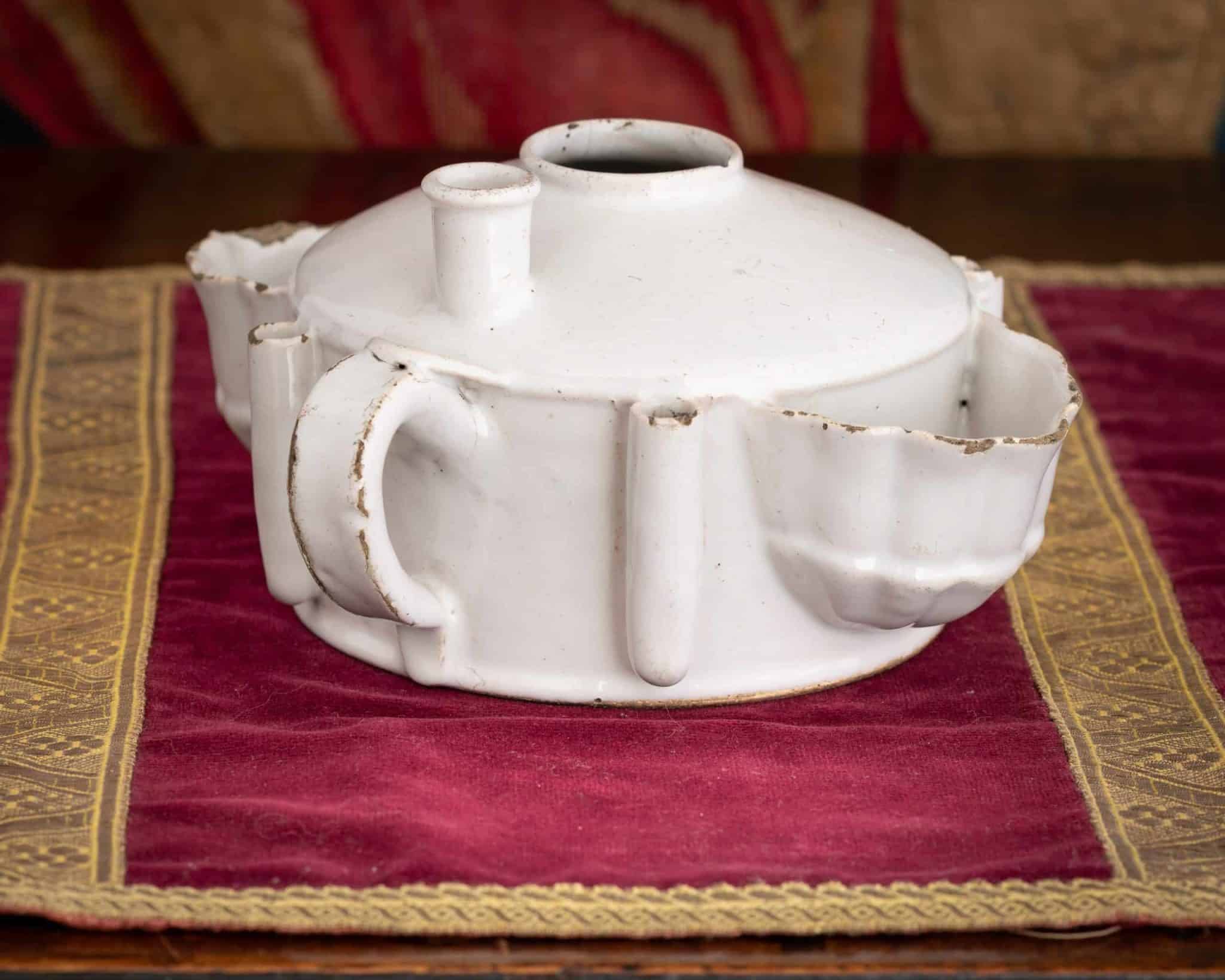
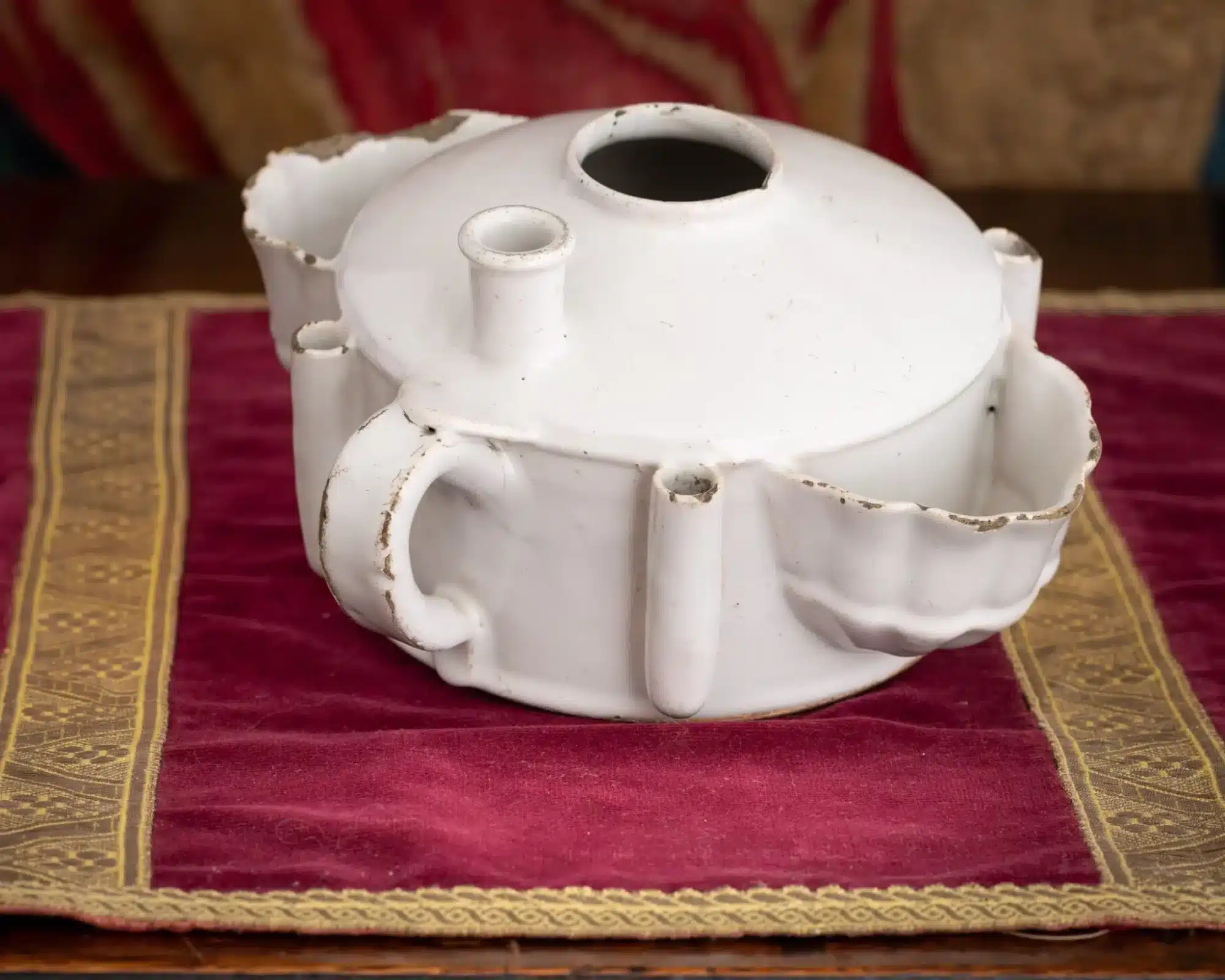
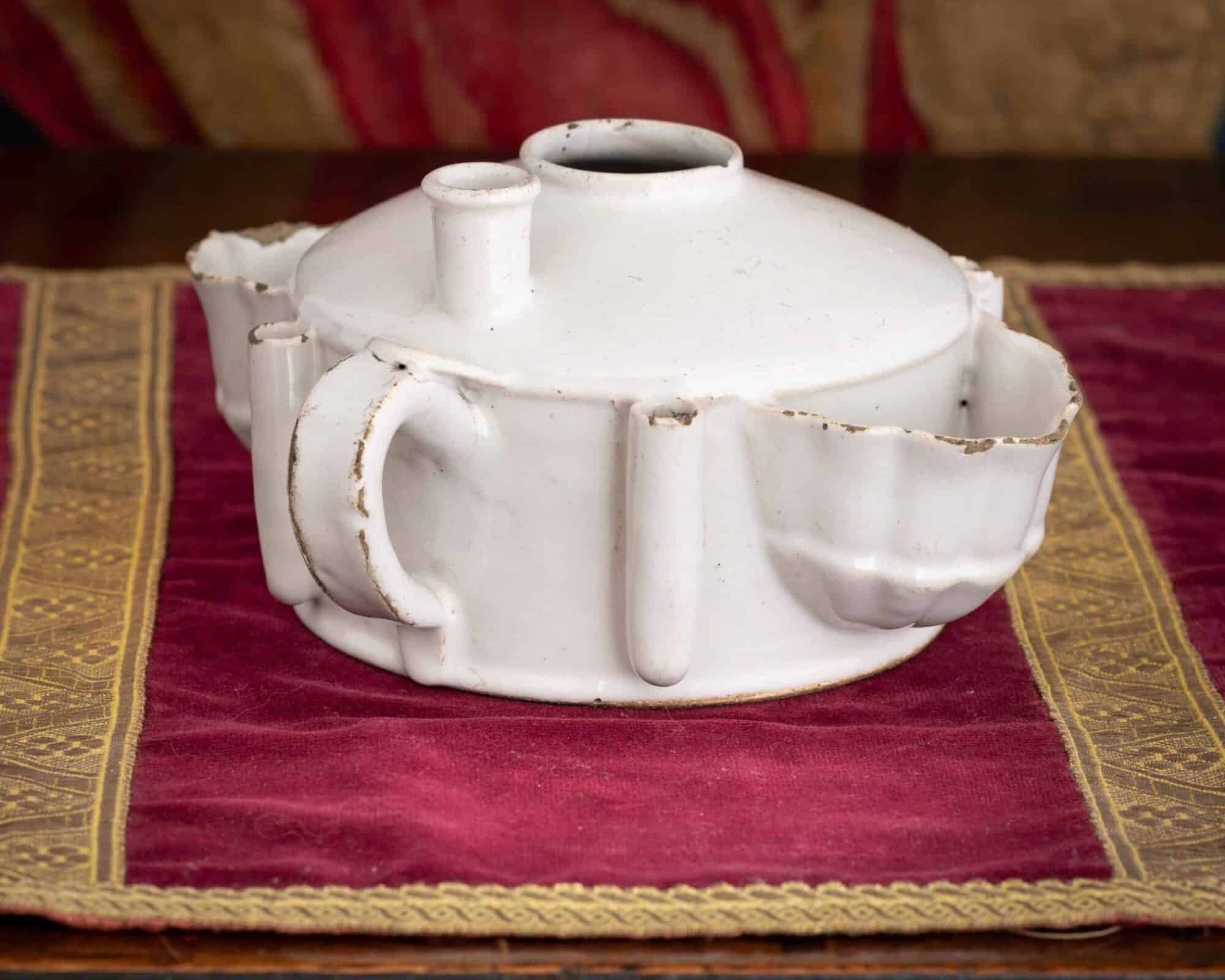
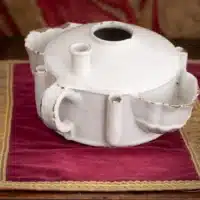
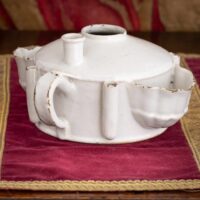
English Delftware Perfuming Dish or Table Ornament
- Period
- 1660 - 1680
- Origin
- London (Southwark or Lambeth)
- Dimensions
- W 9" × H 4 1/4" × D 7 1/2"
- Reference
- #Marh3700
This piece has been sold. It is shown here for reference in our archive.
Description
Tin-glazed earthenware (white delft)
This exceptionally rare and inventive form represents one of the most imaginative achievements of the English delft potteries of the Restoration period. Thrown and modelled in white tin-glazed earthenware, the circular body is fitted with a single strap handle terminating in a moulded scroll, two large lobed and scalloped bays, four short upright tubular spouts, and a central circular socket. The underside shows the characteristic buff earthenware body with triple stilt scars and a wiped footrim, all indicative of the London delft workshops at Southwark or Lambeth active during the third quarter of the seventeenth century.
The precise function of this intriguing vessel lies between table ornament, flower holder, and perfuming dish. The central aperture likely held a removable metal candle cup or perfuming funnel, while the surrounding small tubes could receive short flower stems or narrow tapers, and the broad flanking scalloped recesses may have served as decorative shell-like reservoirs for scented water or floral display. Such hybrid forms epitomise the Restoration fashion for elaborate table furnishings combining fragrance, light, and ornament—an English parallel to the more familiar Dutch tulipière or table fountain developed later in the century.
The unadorned white tin glaze, without polychrome or blue decoration, reflects the early and more restrained phase of English delft production, admired for its purity and sculptural quality. Only a handful of comparable examples are recorded: one in the Victoria and Albert Museum (C.66-1910), another in the Museum of London (A15722), and a related Brislington example in the Bristol Museum (K3504). These pieces are all dated to circa 1660–80 and are attributed to the London workshops supplying the capital’s affluent households after the Restoration.
Vessels of this type are of the greatest rarity, seldom surviving intact owing to their fragile construction and experimental purpose. The present example, despite expected fritting and rim losses, remains an important document of English delft innovation, bridging the traditions of practical domestic pottery and the sculptural extravagance of the late-seventeenth-century table.