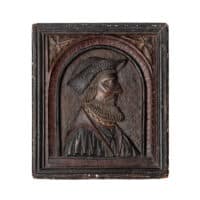
Henry VIII period carved oak portrait panel of a bearded man
- Period
- Circa 1530
- Origin
- England
- Dimensions
- W 10 1/4"" × H 11 1/2"" × D 3/4""
- Reference
- #Marh3775
£10,000
Description
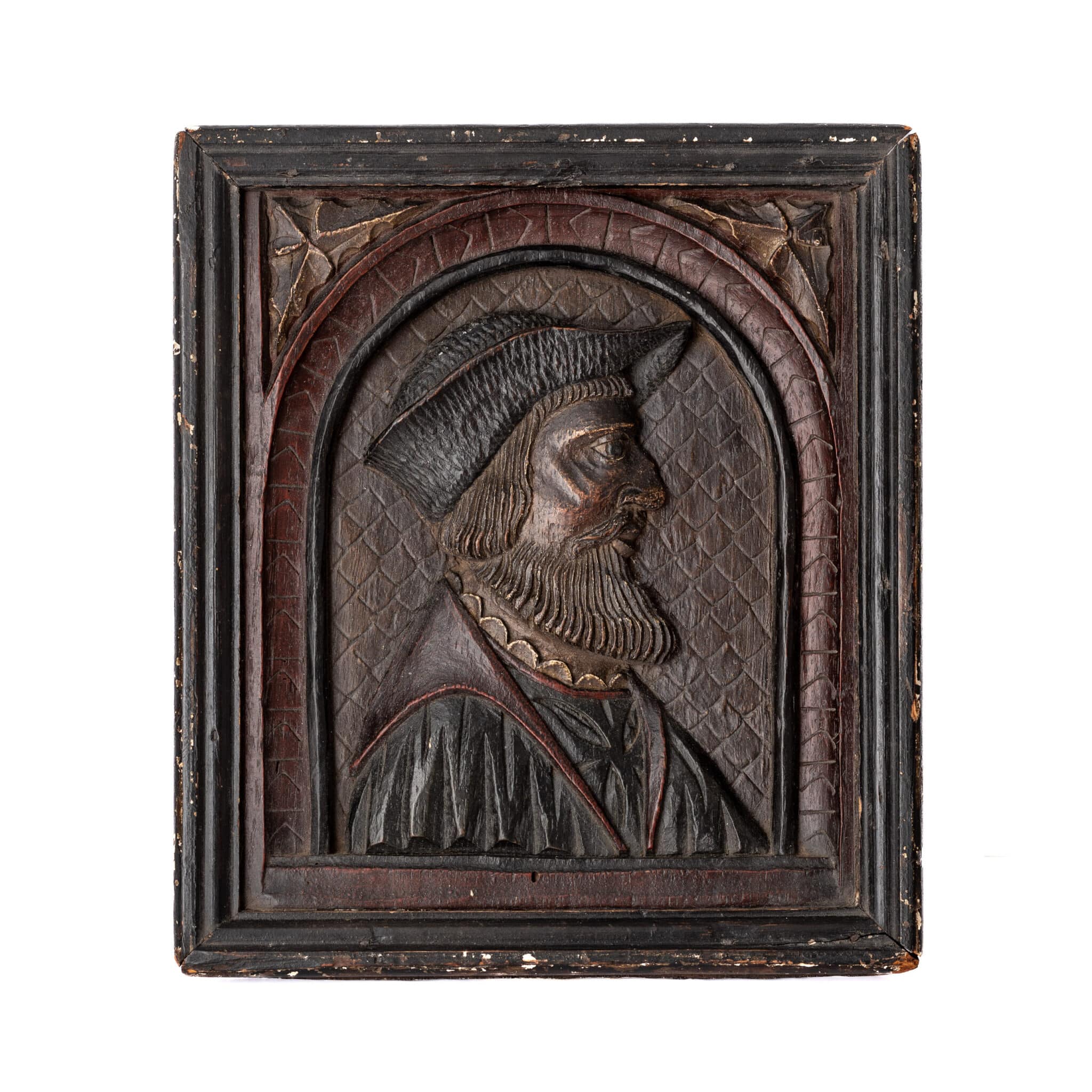
A Henry VIII period carved oak portrait panel of a bearded man, retaining extensive early polychromy.
The sitter is represented in right-facing profile, wearing a broad, angular cap over short hair, with a prominent moustache and long, carefully delineated beard. His dress consists of a dark outer garment with a broad turned-back collar, beneath which is visible the scalloped edge of his shirt, highlighted in ochre-gold. The strongly modelled profile, with pronounced brow, nose and jaw, is cut in comparatively high relief.
The portrait is set against a carved ground of overlapping scale ornament and contained within a round-headed architectural frame. The arch is enriched with a repeated leaf-like motif and flanked in the upper spandrels by stylised foliate carving. The whole is enclosed within its substantial moulded oak frame.
Especially notable is the survival of the early polychrome surface, with deep red, black, brown and ochre-gold decoration remaining across the cap, costume, architectural surround and facial details. The colour is integral to the conception of the carving, articulating individual elements of dress and ornament and giving a valuable impression of the original decorative character of the panel.
The sitter’s identity is presently unknown. His costume and the manner of representation, however, belong to the portrait vocabulary of Henrician England, when profile likenesses of distinguished secular figures were employed across a range of media. The directness of the profile and strongly characterised physiognomy suggest that the carving was intended as a portrait rather than a generic figure.
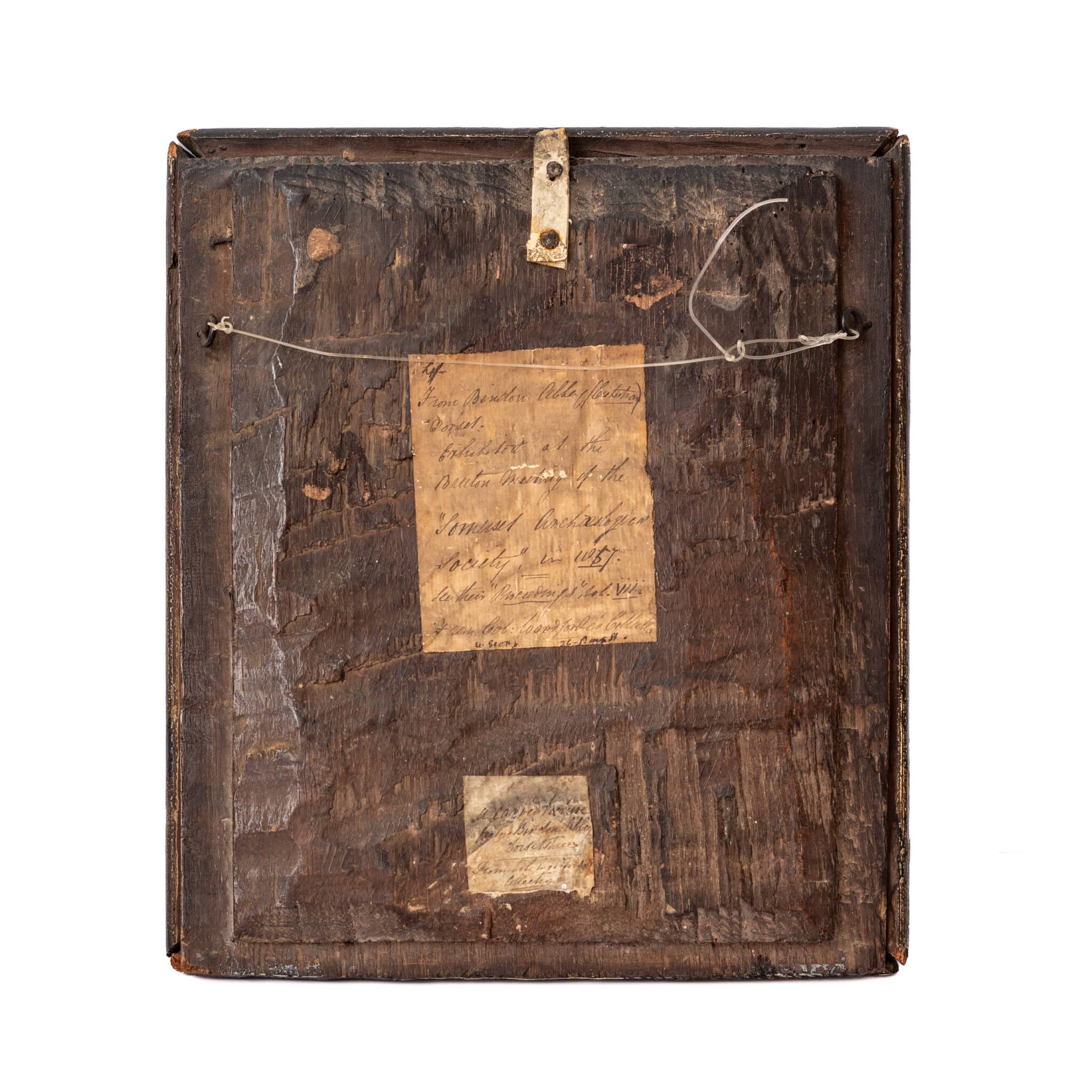
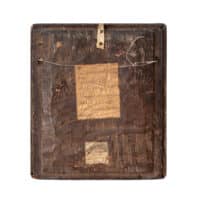
The reverse retains historic handwritten labels and earlier hanging fittings. Of particular interest is a nineteenth-century inscription recording an earlier provenance and the panel’s exhibition at a meeting of the Somerset Archaeological Society in 1887, providing an important documentary record of the panel’s history and antiquarian appreciation.
Provenance:
Traditionally recorded as from Burton Abbey, according to historic handwritten labels preserved on the reverse;
exhibited at a meeting of the Somerset Archaeological Society, 1887, as recorded on an old manuscript label;
subsequently in an unidentified private collection, according to a further early label on the reverse.