
• Current Stock
  • Archive
  • Notable Works
  • About Us
  • News
  • Contact
Home / Current Stock / Late Gothic Brass Ho…
Previous Next
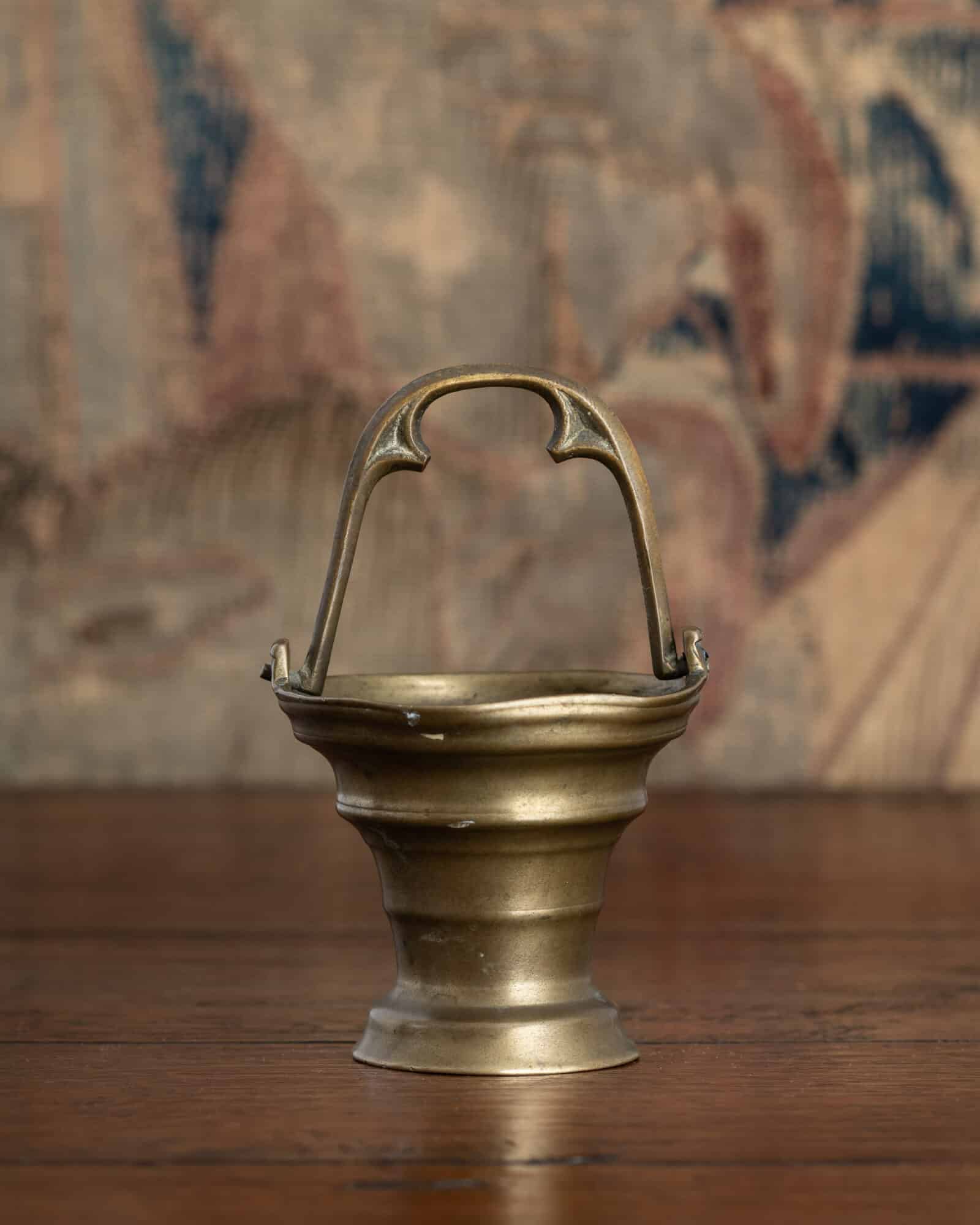
Late Gothic Brass Holy-Water Bucket (Weihwassereimer)

Late Gothic Brass Holy-Water Bucket (Weihwassereimer)

Period
Circa 1500–1520
Origin
German
Dimensions
W 4" diameter" × H 3 1/2""
Reference
#Marh3793

£850

Description

A small early sixteenth-century cast and turned brass holy-water bucket, the waisted cylindrical body formed with pronounced horizontal mouldings and a spreading circular foot. Retaining its cast brass swing handle, formed as a rounded Gothic arch with distinctive inward-facing cusps and attached to integral lateral supports.

The vessel belongs to a recognised group of German Weihwassereimer produced around and shortly after 1500. Such vessels were principally intended for holy water, both within the church and, in smaller forms, for private devotional use.

Condition: Retaining a pleasing, largely untouched surface with the expected wear and irregularities of an object of this age. There is historic deformation to the body and an old split to the edge of the spreading foot, together with minor knocks and surface marks acquired through use. These remain part of the vessel’s long history and do not detract from its strong sculptural form or early character.

Literature: Compare Hermann P. Lockner, Messing: Ein Handbuch über Messinggerät des 15.–17. Jahrhunderts, figs. 209–215, for closely related German holy-water buckets dated circa 1500 and later.
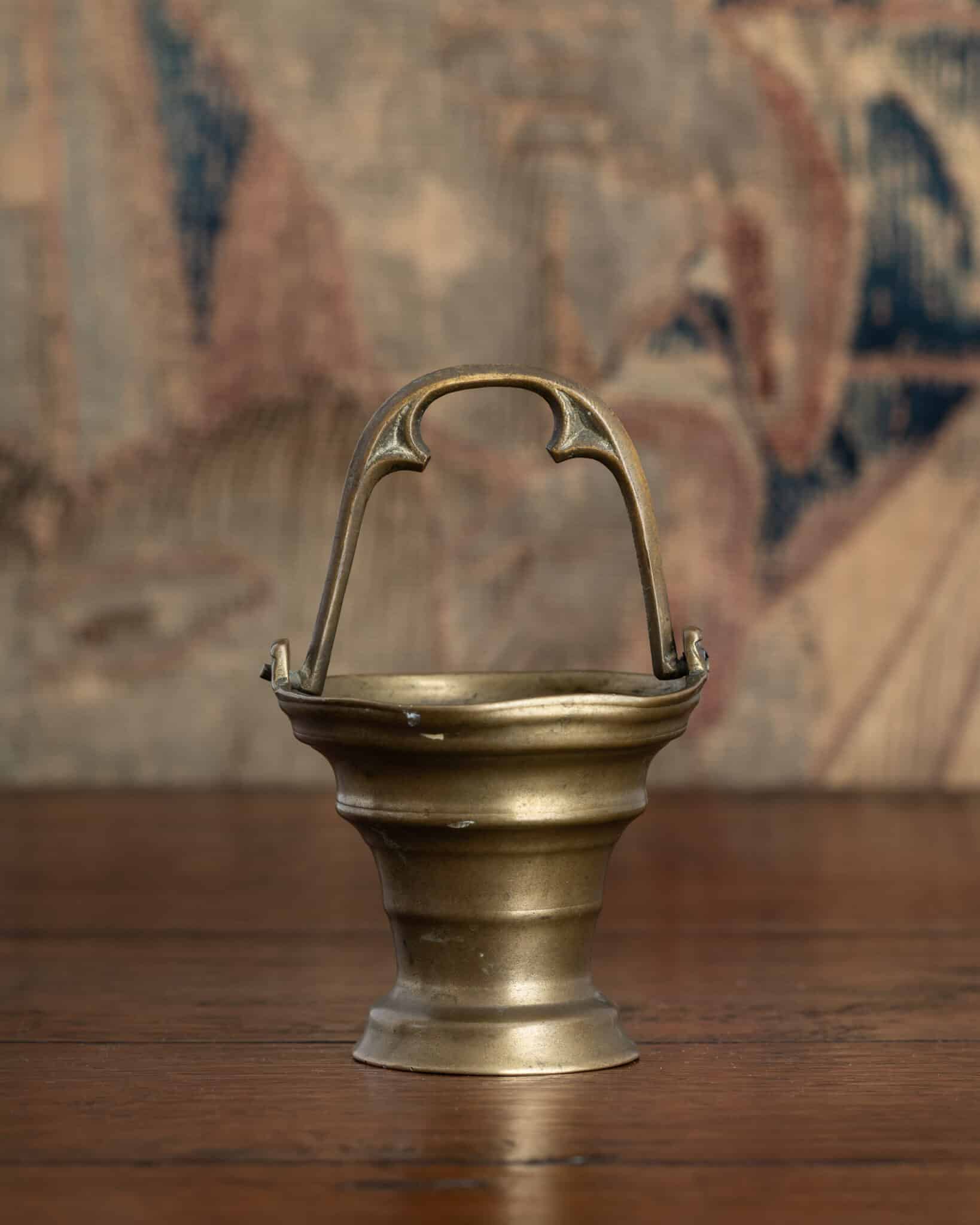
Holy-water buckets (Weihwassereimer) formed part of the practical equipment of the late-medieval church. Filled with consecrated water, they accompanied the priest during the asperges, when holy water was sprinkled over the congregation, altar and sacred spaces, generally using an aspergillum carried alongside the vessel.

Brass was particularly suited to ecclesiastical use: durable, easily cleaned and possessing a warm golden appearance that complemented the candlesticks, aquamaniles and other metalwork of the church interior. Smaller examples were also used within private households, where holy water formed part of everyday devotional practice.

The substantial swing handle allowed the vessel to be carried during processions and other liturgical ceremonies, explaining the distinctly functional character of these surviving early-sixteenth-century examples.

Curator's Note

Previous A Flemish Oak Panel… Next Late Gothic Netherla…
  • Late Gothic Brass Holy-Water Bucket (Weihwassereimer)

Newsletter

New Stock, Direct to Your Inbox.

Be among the first to hear about new acquisitions and notable works.

Please enable JavaScript in your browser to complete this form.
Loading
  • Current Stock
  • Archive
  • Notable Works
  • About Us
  • News
  • Contact

Contact Us

+44 (0)777 903 8891

  • Pinterest
  • Instagram

By Appointment

Devon, England.

Paul Fitzsimmons

Specialist in early oak furniture and works of art.

© 2026 Paul Fitzsimmons | Website by Dancing Badger Ltd

  • Privacy Policy
  • Terms & Conditions

Search the collection

Search in

    Enquire About This Piece

    Late Gothic Brass Holy-Water Bucket (Weihwassereimer) · Ref. Marh3793

    Please enable JavaScript in your browser to complete this form.
    Newsletter signup
    Loading
    1 / 1