Late Gothic Netherlandish Oak Group of God the Father Supporting the Dead Christ
- Period
- Circa 1480–1510
- Origin
- Southern Netherlands
- Dimensions
- W 6 3/4"" × H 13 1/4"" × D 5""
- Reference
- #Marh3794
£6,850
Description
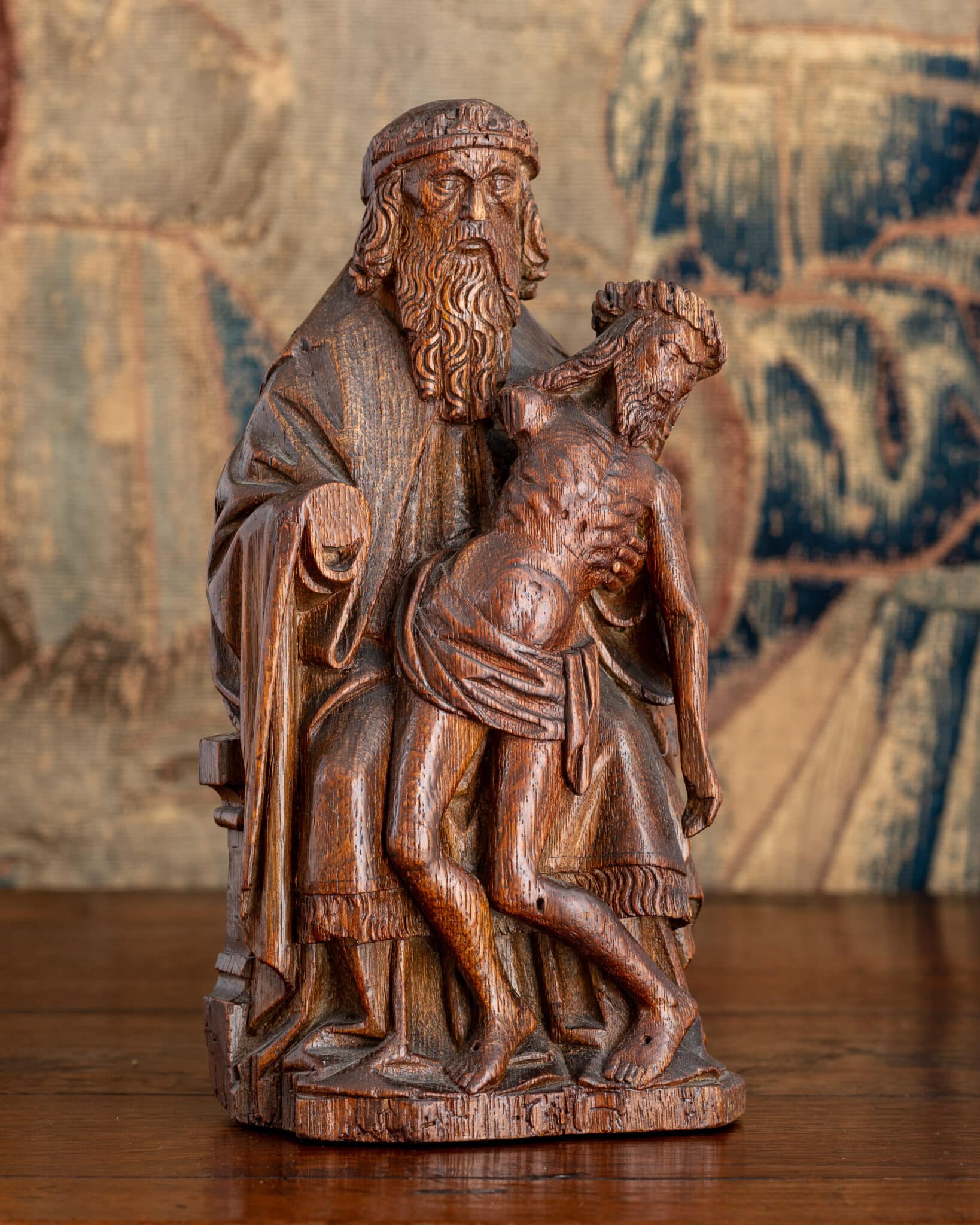
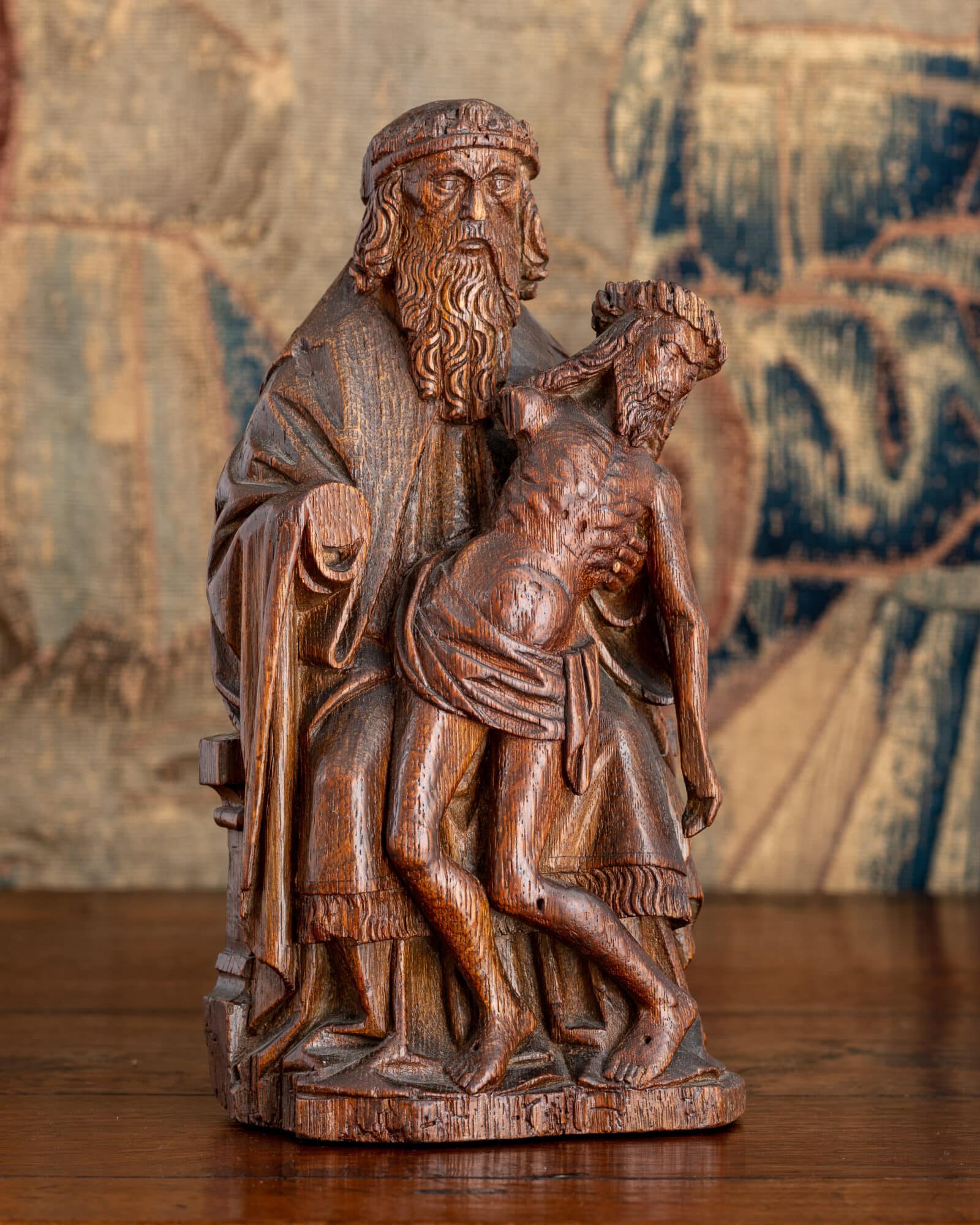
A finely carved Late Gothic oak devotional group depicting God the Father supporting and presenting the dead body of Christ, an iconographic type known in the Netherlands as the Vader-Pietà, and closely associated with the medieval tradition of the Throne of Grace or Gnadenstuhl.
God the Father is represented enthroned as a crowned and venerable patriarch. His long hair falls in deeply carved curling locks beside the face, while the exceptionally full beard descends in strongly defined, flame-like strands over his chest. He wears a long robe beneath a substantial mantle, the broad and angular folds of which frame the central figure of Christ.
The lifeless Christ is supported before the Father, his body falling diagonally across the composition. His head inclines heavily beneath the Crown of Thorns, while the arms hang downwards and the legs cross at the ankles. Particular attention has been given to the modelling of the torso, with the ribcage, abdomen and musculature deliberately emphasised to convey the physical suffering of the Passion and the vulnerability of the dead body.
The composition derives from the medieval Throne of Grace, in which God the Father presents the sacrificed Christ to mankind. In this more intimate variation the Cross itself is absent and the Father physically supports the body of his dead Son, bringing the imagery particularly close to that of the Pietà. The resulting image combines the theological significance of Christ’s sacrifice with an intensely human expression of paternal grief.
The sculptor has carefully contrasted the two figures. The Father remains monumental and essentially frontal, his gaze directed towards the beholder, while Christ’s body collapses across him with considerable naturalism. The diagonal movement of Christ’s limbs is counterbalanced by the strong vertical axis formed by the Father’s crowned head, long beard and seated figure.
The deeply incised treatment of the hair and beards, angular drapery, elongated proportions and strongly articulated anatomy belong firmly within the sculptural traditions of the Southern Netherlands during the closing decades of the fifteenth century and beginning of the sixteenth.
The sculpture is carved principally for frontal viewing. Although the sides are substantially worked, the reverse is comparatively flat and only summarily finished. Together with the architectural elements flanking the seated Father, this suggests that the group may originally have occupied a niche or formed part of a small devotional altarpiece or tabernacle, where it would have provided the principal focus for private or ecclesiastical devotion.
The oak retains a warm, naturally aged surface with historic shrinkage and evidence of old insect activity. The original polychrome decoration has been lost, allowing the vigorous character of the carving and the sculptor’s handling of the oak to be clearly appreciated.