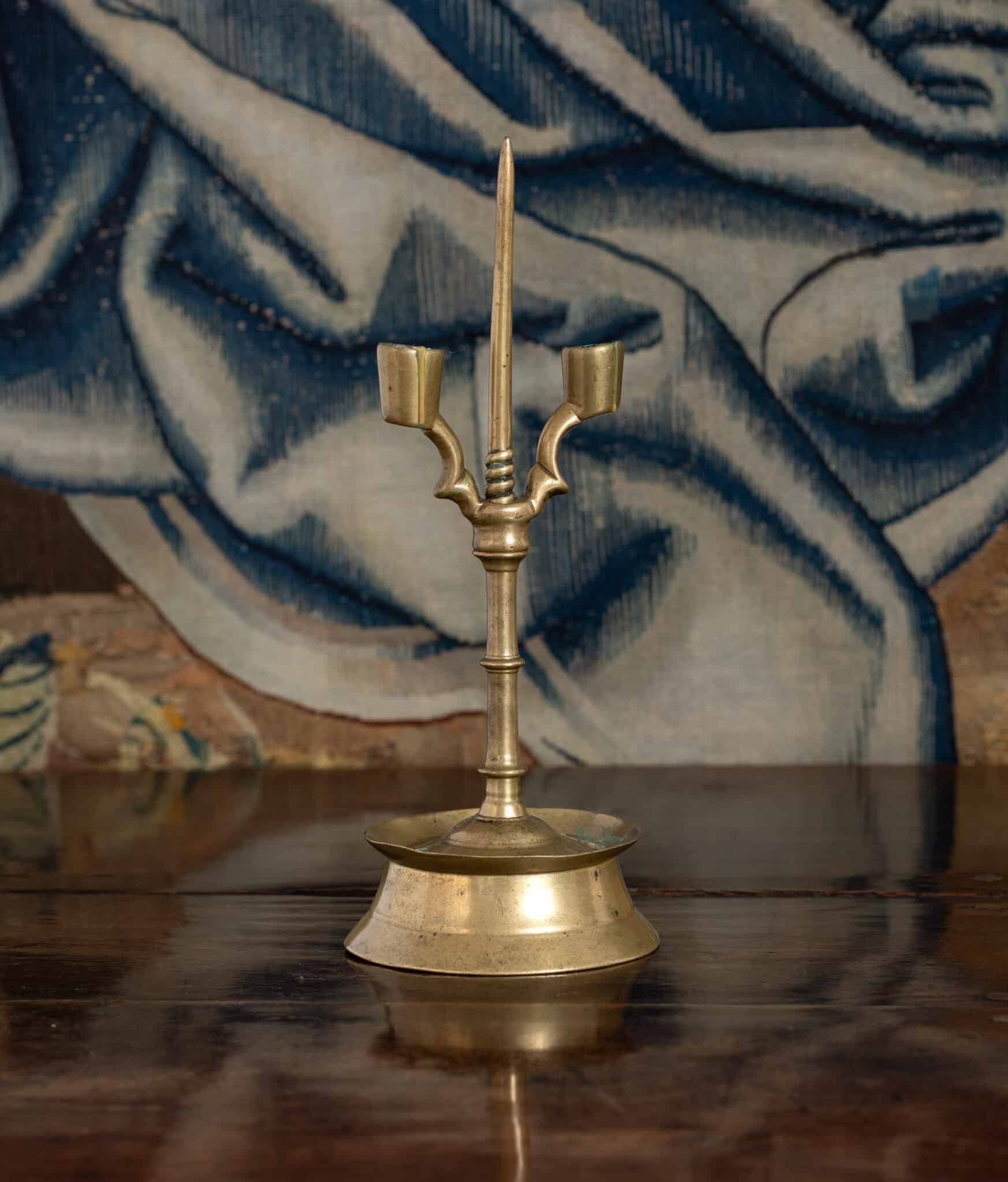
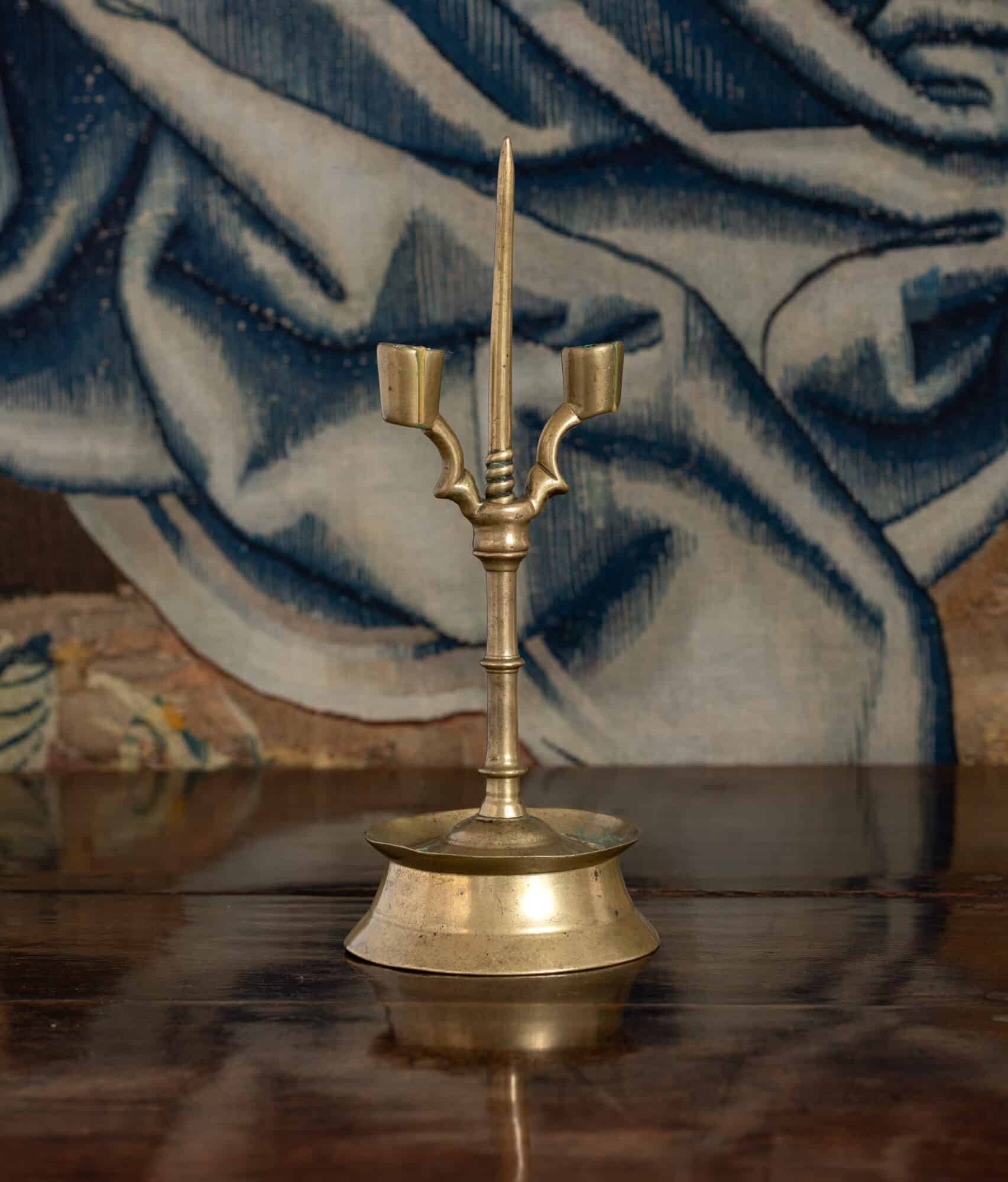
Late Gothic Double-Socket Candlestick with Central Spike
- Period
- 1450 - 1500
- Origin
- North-West Europe, probably the Low Countries
- Reference
- #Marh3737
£8,500
Description
A late medieval copper-alloy candlestick belongs to a distinctive group of North-West European Gothic lighting devices characterised by a central spike flanked by two candle sockets. Cast as a single unit, the upper section comprises a pair of slightly splayed cylindrical sockets connected by angular moulded arms to a central collar from which rises a tapering spike. The stem is formed with a series of turned mouldings above a broad circular drip-pan and spreading conical foot.
The form closely corresponds to examples recorded in The Lear Collection: A Study of Copper-Alloy Socket Candlesticks A.D. 200–1700 by Christopher Bangs, particularly No. 26, which is attributed to North-West Europe and dated to the fifteenth century. The distinctive arrangement of paired sockets and central spike is recognised as a characteristic late Gothic type. Although the precise purpose of the spike has been debated by scholars, such objects are generally classified as candlesticks rather than rushlight holders, the spike possibly serving a secondary lighting or practical function.
The restrained architectural modelling of the stem, the angular profile of the arms, and the robust cast construction are all consistent with late medieval metalworking traditions. Candlesticks of this type are considerably rarer than the more familiar single-socket forms and represent a sophisticated development in domestic and ecclesiastical lighting during the closing centuries of the Middle Ages.
Comparative literature:
Christopher Bangs, The Lear Collection: A Study of Copper-Alloy Socket Candlesticks A.D. 200–1700, no. 26, pp. 220–221.